How machines learn to think is one of the most exciting questions in modern technology. Have you ever wondered how your phone suggests the next word, or how a map app finds the fastest route? The answer isn’t magic. It’s a layered set of ideas built over decades by curious researchers.
In this guide, we’ll explore how machines learn to think by looking at the hidden foundations of computational agents. We’ll keep things clear, practical, and optimistic. Whether you’re a student, a curious reader, or a working professional, you’ll leave with a solid mental model of how intelligent machines work. You might also enjoy our beginner’s guide to artificial intelligence and our explainer on machine learning basics for extra background.
How Machines Learn to Think: What Does “Thinking” Really Mean?
Before we dive in, let’s agree on what “thinking” means for a machine. People often picture a robot with human-like thoughts. In reality, machine thinking is more down-to-earth. It’s about taking in information, making sense of it, and choosing a useful action.
Thinking vs. Computing
A basic calculator computes. It follows fixed steps and never changes. A thinking machine, by contrast, can handle situations it hasn’t seen before. It weighs options, predicts results, and improves over time.
| Feature | Simple Computing | Machine “Thinking” |
|---|---|---|
| Follows fixed rules | Yes | Sometimes |
| Learns from experience | No | Yes |
| Handles new situations | Rarely | Often |
| Makes choices toward a goal | No | Yes |
Of course, machines don’t “feel” or “understand” the way we do. Researchers still debate whether they ever will. What we can say is that they show intelligent behavior, and that’s a great place to start.
Why Understanding How Machines Learn to Think Matters Today
Intelligent systems now help doctors read scans, help farmers plan harvests, and help students learn languages. Understanding how machines learn to think helps us use these tools wisely. It also helps us spot their limits, which is just as important. After all, a tool you understand is a tool you can trust.
The Agent Idea: Core Foundation of How Machines Learn to Think
If you take away only one idea from this article, make it the agent. In computer science, an agent is anything that perceives its surroundings and acts on them. This framing, popularized in textbooks like Artificial Intelligence: A Modern Approach, unifies almost everything we call AI.
Sensors, Actuators, and Environments
Every agent has three basic parts:
- Sensors: These collect information. For a robot, that might be cameras. For a chatbot, it’s the text you type.
- Actuators: These carry out actions. Think of wheels, a robot arm, or words on a screen.
- Environment: This is the world the agent lives in, whether it’s a warehouse, a game board, or the internet.
The agent’s “brain” sits in the middle. It reads the sensor data and picks an action. Then the cycle repeats. That loop is the heartbeat of every computational agent.
Rational Agents and Good Decisions
Researchers like to talk about rational agents. A rational agent picks the action expected to give the best outcome, based on what it knows. Notice the careful wording. Rational doesn’t mean perfect. It means doing the best possible with the information at hand.
A thermostat is a very simple agent. It senses temperature and turns heating on or off. A self-driving car is a far more complex one. Yet both follow the same basic pattern, and that’s the beauty of the agent idea.
Insight 1: Representation Shows How Machines Learn to Think About the World
The first big insight is representation. Before a machine can reason about the world, it needs a way to describe the world inside its “mind.”
Imagine planning a road trip. You don’t picture every blade of grass. Instead, you picture a map with cities and roads. Machines do the same thing. They simplify reality into useful structures.
Common ways to represent knowledge include:
- Graphs: Nodes and links, perfect for maps, social networks, and routes.
- Logic statements: Facts and rules such as “all birds have wings.”
- Vectors of numbers: A list of numbers that captures an image, a word, or a song.
- Probability tables: Numbers that show how likely different events are.
Choosing the right representation is half the battle. A good one makes hard problems easy. A poor one makes easy problems impossible. In fact, many breakthroughs in AI came from finding a smarter way to represent information, not from faster hardware alone.
Modern language models, for example, turn words into long lists of numbers. Words with similar meanings end up close together in this number space. That’s how a machine can notice that “doctor” and “physician” are cousins.
Insight 2: Search and Planning Help Machines Learn to Think Ahead
Once a machine has a representation, it can start solving problems. The second insight is that many problems come down to searching through possible choices. In other words, the machine imagines different futures and picks the best path.
Classic Search Methods
Picture a maze. A machine could try every path one by one. That works for tiny mazes but fails for huge ones. So researchers developed smarter strategies:
- Breadth-first search: Explore all nearby options before going deeper.
- Depth-first search: Follow one path as far as it goes, then backtrack.
- A* search: Use a clever estimate of the remaining distance to guide the search.
A* is a favorite in video games and map apps. It balances the cost of the path so far with a guess about how far the goal is. As a result, it finds good routes quickly without wasting effort.
Planning in the Real World
Planning goes one step further. Instead of finding a single path, the agent builds a whole sequence of actions to reach a goal. A warehouse robot, for instance, must decide which shelf to visit first, how to avoid other robots, and when to recharge.
Chess programs show this nicely. They look many moves ahead, scoring each possible board. They can’t check every possibility, so they use shortcuts to ignore hopeless branches. This “looking ahead” ability is a cornerstone of strategic machine intelligence.
Insight 3: Data Changes How Machines Learn to Think
For many years, programmers wrote rules by hand. It worked, but it was slow and brittle. Then came a game-changing idea: let the machine learn the rules from examples. This is where the phrase “machine learning” comes from.
Supervised, Unsupervised, and Reinforcement Learning
There are three main flavors of learning. Each fits a different kind of problem.
| Type | How It Works | Everyday Example |
|---|---|---|
| Supervised learning | Learns from labeled examples | Spam filters that learn from marked emails |
| Unsupervised learning | Finds hidden patterns without labels | Grouping customers by shopping habits |
| Reinforcement learning | Learns by trial, error, and rewards | A program mastering a video game |
Supervised learning is like studying with an answer key. Unsupervised learning is like sorting a pile of photos without being told the categories. Reinforcement learning is like training a puppy with treats. Many modern systems blend all three.
Neural Networks: How Machines Learn to Think in Plain English
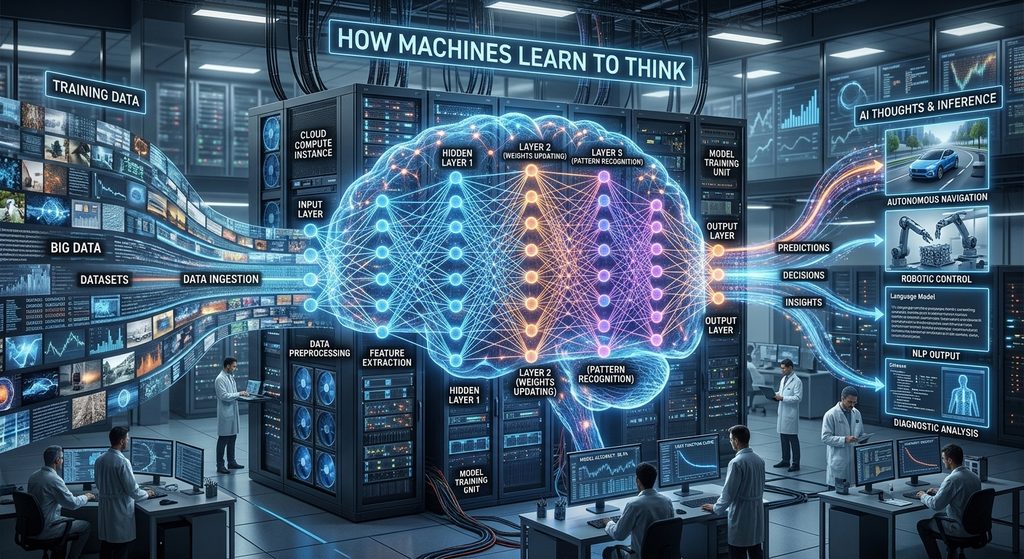
You’ve probably heard of neural networks. Here’s the simple version. A neural network is a web of tiny math units, loosely inspired by brain cells. Each unit takes in numbers, adjusts them slightly, and passes them along.
At first, the network’s guesses are poor. But after seeing thousands or millions of examples, it tweaks its internal settings, called weights, to make fewer mistakes. This process is known as training. Over time, the network can recognize faces, translate languages, or write helpful summaries.
What’s remarkable is that no one tells the network exactly what to look for. It discovers useful patterns on its own. That’s a big reason learning-based systems have taken off in the past decade.
Insight 4: Reasoning Under Uncertainty Is Key to How Machines Learn to Think
The real world is messy. Sensors make errors, information is missing, and surprises happen. So smart agents must reason under uncertainty.
Think about a weather app. It can’t say for sure that it’ll rain tomorrow. Instead, it says there’s a 70% chance. That’s probabilistic thinking, and it’s one of the most useful tools in the AI toolbox.
Key ideas here include:
- Probability: A number between 0 and 1 that measures how likely something is.
- Bayes’ rule: A method for updating beliefs when new evidence arrives.
- Bayesian networks: Diagrams that show how different uncertain facts connect.
- Decision theory: A way to combine probabilities with the value of each outcome.
Suppose a medical program sees a symptom. It starts with a base rate for each illness. Then it adjusts those numbers using test results. Finally, it suggests the most likely cause, along with how confident it is. Honest confidence is a sign of a trustworthy system.
Machines that handle uncertainty well tend to be safer and more useful. They know when to act and when to ask for help. In short, learning to say “I’m not sure” is a surprisingly advanced skill.
Insight 5: Feedback Loops Help Machines Learn to Think and Adapt
Next, let’s talk about feedback. A feedback loop means the results of an action flow back to the agent, helping it adjust. Without feedback, an agent would repeat the same mistakes forever.
Consider a robot vacuum. It bumps into a chair, notes the location, and avoids it next time. Or think of a streaming service that watches what you skip and what you finish. Each choice you make teaches the system a little more about your tastes.
In reinforcement learning, feedback arrives as a reward. The agent tries something, gets a score, and shifts toward actions that earn higher scores. Over thousands of attempts, surprisingly clever behavior can appear.
However, feedback needs care. If the reward is poorly designed, the agent may find sneaky shortcuts. A cleaning robot rewarded for “no visible mess” might simply hide the mess! Designers therefore spend lots of time shaping rewards that match what people truly want. This lesson reminds us that how machines learn to think depends heavily on the goals we set.
Insight 6: Memory and Knowledge Make Agents Smarter
Humans don’t start from scratch every morning, and neither should machines. Memory and stored knowledge supercharge an agent.
There are a few kinds of memory in computational agents:
- Short-term memory: Keeps track of the current task or conversation.
- Long-term memory: Stores facts, past experiences, and learned skills.
- External memory: Uses databases or documents the agent can look up.
Modern assistants often combine these. For instance, an AI system might read your question, search a trusted database, and then craft an answer using what it found. This approach helps reduce errors and keeps answers fresh.
Knowledge also comes from transfer. A model trained on a huge amount of general text can be fine-tuned for a narrow job, like legal summaries or customer support. It’s like a student who learned broad basics and then specialized. Consequently, new applications can be built faster and with less data.
Good knowledge also needs good quality control. If an agent learns from flawed sources, it may repeat those flaws. That’s why careful data curation is a hidden but vital foundation of machine intelligence.
Insight 7: Ethics and Safety Guide How Machines Learn to Think Next
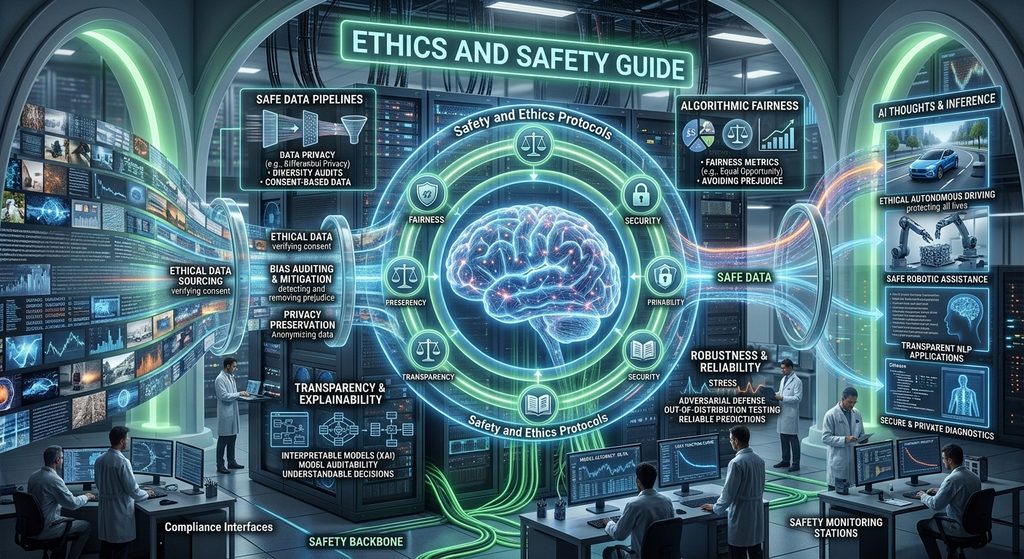
Finally, no discussion of how machines learn to think is complete without ethics. As agents grow more capable, we need to make sure they’re fair, safe, and helpful.
Here are the main concerns researchers and policymakers discuss:
- Bias: If training data reflects unfair patterns, the model may too.
- Transparency: People deserve to know why a system made a decision.
- Privacy: Personal information must be handled with care.
- Safety: Systems should behave reliably, even in unusual situations.
- Accountability: Humans must remain responsible for how AI is used.
The good news? Progress here is real. Teams now test models for bias, publish documentation about limits, and invite outside experts to review their work. Moreover, many universities and companies treat safety research as a top priority.
If we build wisely, intelligent agents can help tackle huge challenges, from climate modeling to personalized education. The future looks bright, especially when engineers, scientists, and everyday people all join the conversation.
Frequently Asked Questions About How Machines Learn to Think
1. How do machines learn to think?
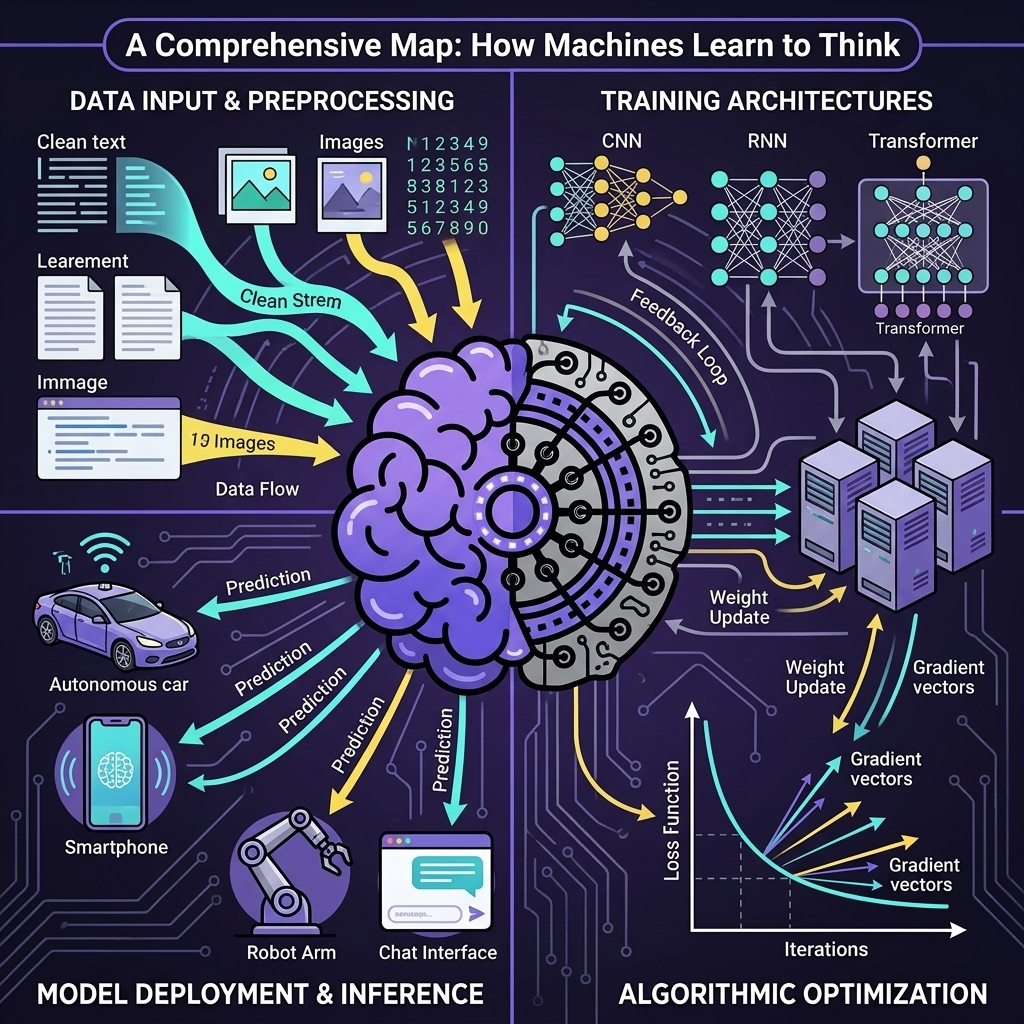
Machines learn to think by combining several building blocks. They represent the world with data structures, search through options, learn patterns from examples, and adjust using feedback. No single trick does it all. Instead, these ideas work together inside an agent that senses and acts.
2. Can machines really think like humans?
Not exactly. Machines can perform tasks that seem intelligent, such as translating text or spotting objects in photos. But they don’t have human feelings, awareness, or lived experience. Scientists still debate what “real” thinking means, so it’s an exciting open question.
3. What is a computational agent?
A computational agent is a program or system that perceives its environment and takes actions to reach goals. A thermostat, a chess engine, and a smart assistant all fit the definition. They differ mainly in complexity.
4. What’s the difference between AI and machine learning?
AI is the broad goal of making machines act intelligently. Machine learning is one popular method for reaching that goal, where systems learn from data instead of following hand-written rules. In other words, machine learning is a part of AI, not a separate thing.
5. Why does data matter so much in machine learning?
Data is the “experience” a model learns from. More varied, high-quality data usually leads to better results. Poor or biased data, on the other hand, can lead to poor or unfair outcomes. So collecting and cleaning data is a crucial step.
6. Do I need to be good at math to understand AI?
You don’t need advanced math to grasp the big ideas. Everyday reasoning, curiosity, and a few examples go a long way. If you’d like to build models yourself, though, learning some probability, statistics, and basic programming will help.
7. Is AI safe?
AI can be used safely when it’s designed, tested, and monitored with care. Researchers work on reliability, fairness, and clear oversight. Like any powerful technology, it works best when people stay involved and informed.
Conclusion: The Future of How Machines Learn to Think
So, how machines learn to think isn’t about one secret ingredient. It’s a blend of agents that sense and act, smart representations, search and planning, learning from data, reasoning with uncertainty, feedback, memory, and thoughtful ethics. Each layer builds on the one beneath it.
Understanding these hidden foundations makes the technology less mysterious and far more approachable. You can now look at a voice assistant or a recommendation engine and recognize the ideas working behind the scenes. Better yet, you’re ready to ask smart questions about where this technology is headed.
The story of how machines learn to think is still being written, and there’s plenty of room for new voices. Keep exploring, stay curious, and enjoy the journey. The best chapters may be yet to come!