Why Online Marketing for Small Businesses Trips Up So Many Owners
Online marketing for small businesses sounds simple on paper. You build a website, post a few photos, and customers show up. Unfortunately, that’s rarely how it works. Every day, thousands of owners pour time and money into digital channels and get almost nothing back. Then they decide the internet “just doesn’t work” for their type of business.
Here’s the good news: it does work. The owners who succeed aren’t luckier or richer. They simply follow a smarter process. In this guide, you’ll learn why online marketing for small businesses fails so often, and you’ll get seven proven secrets to help you land in the winning group.
Think of it like gardening. Anyone can throw seeds on the ground. Only the gardener who prepares the soil, waters on schedule, and pulls the weeds gets a harvest. Online marketing rewards the same kind of patience and planning.
What “Failing” Really Means
When people say a business “fails” at online marketing for small businesses, they usually don’t mean the company closes. Instead, they mean one or more of these things:
- The business spends money on ads but can’t tell if the ads work.
- The website gets visitors, but nobody calls, books, or buys.
- Social media accounts sit quiet for weeks at a time.
- The owner feels exhausted and has no clear results to show for it.
Notice that each of these problems is fixable. That’s what makes this topic so encouraging. Failure here is usually a planning problem, not a talent problem.
A Quick Note on the 90% Figure
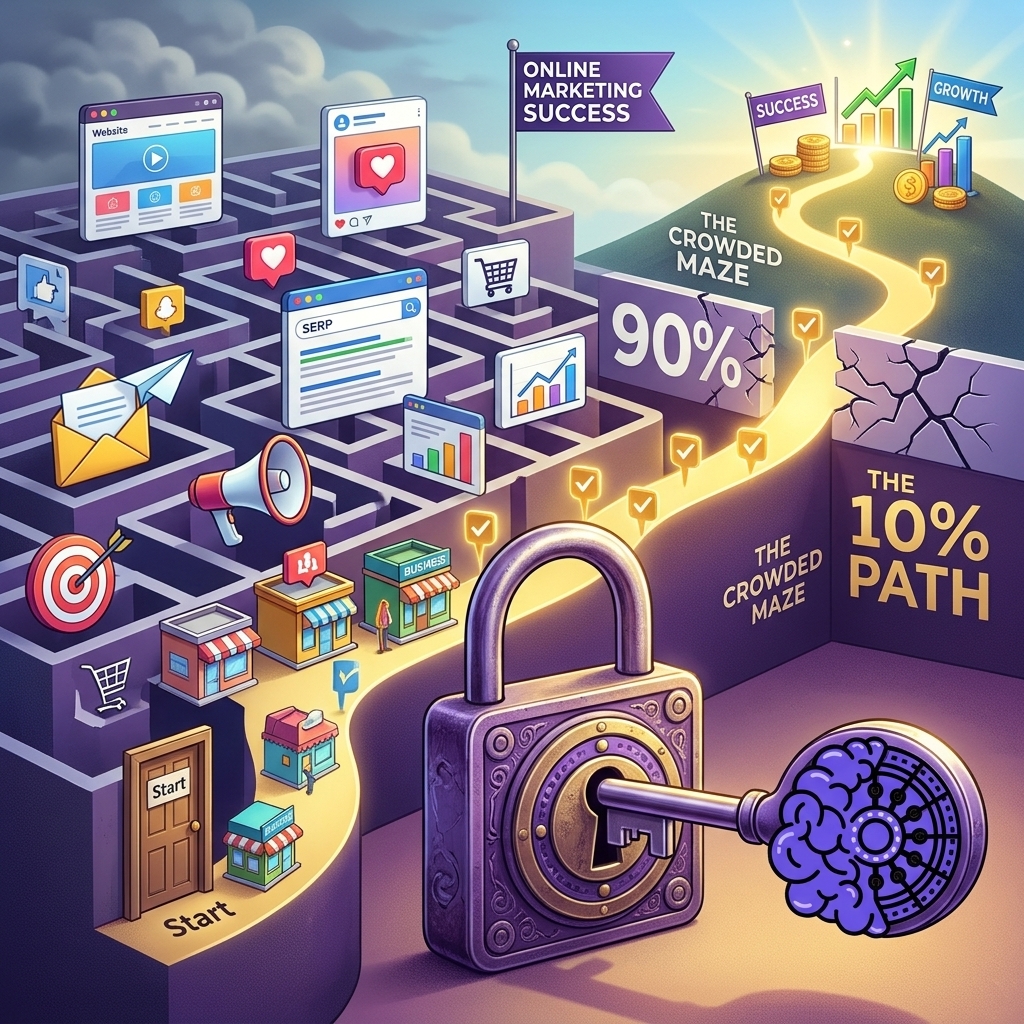
You’ve probably seen the “90%” number in headlines, and it makes a strong point. However, it’s best to treat it as a rough rule of thumb rather than a precise statistic. Studies vary a lot depending on industry, country, and how “success” is defined.
What matters isn’t the exact percentage. What matters is the pattern: most owners don’t get strong returns from online marketing for small businesses, and the ones who do share a few clear habits. Let’s look at why the others struggle first.
The Real Reasons Online Marketing for Small Businesses Fails
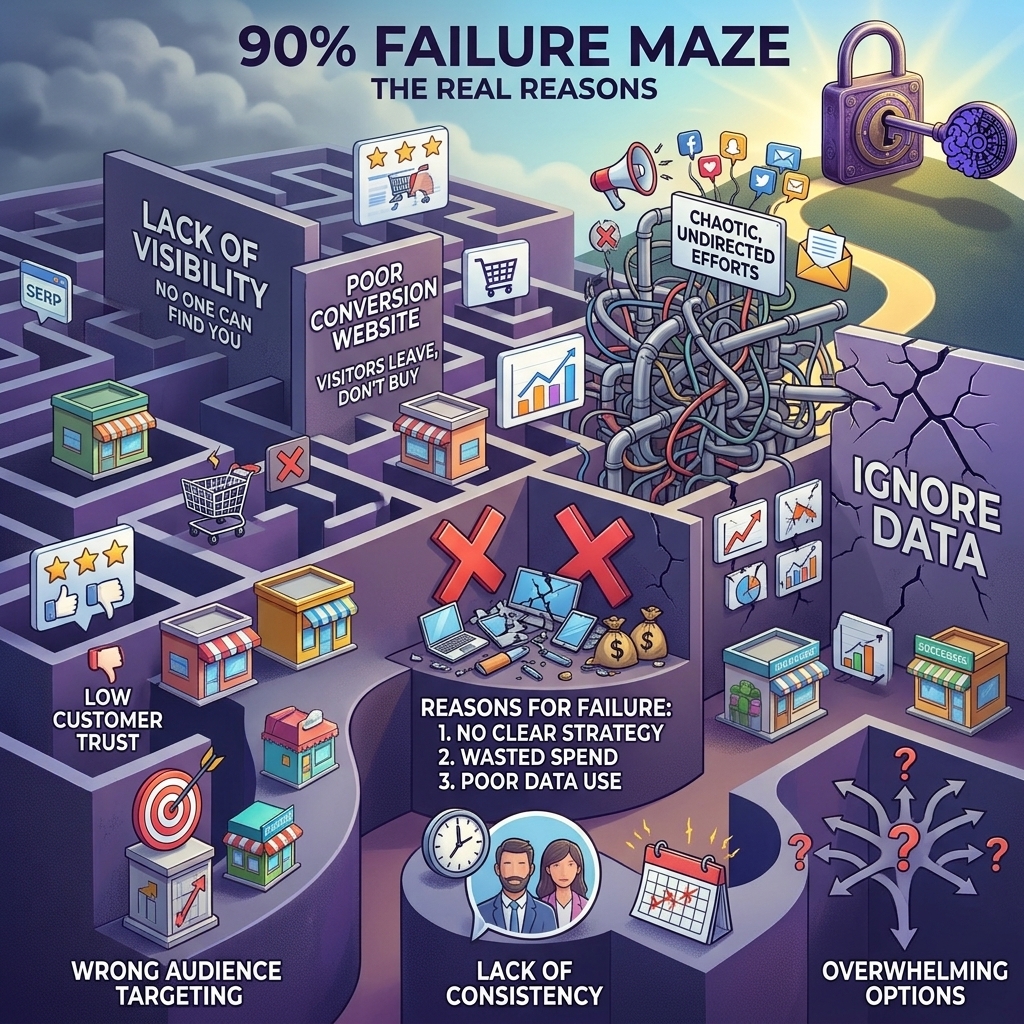
Before we fix the problem, we need to understand it. Most struggling businesses fall into the same three traps. If you recognize yourself in one of them, don’t worry. Awareness is the first step toward change.
Limited Time and Tight Budgets
Small business owners wear many hats. One minute you’re serving a customer, the next you’re doing payroll, and later you’re ordering supplies. Marketing often lands at the bottom of the list, so it gets done in short, rushed bursts.
Tight budgets add pressure too. Because every dollar counts, owners often pick the cheapest option or try to do everything themselves. That’s understandable. Still, scattered effort rarely beats focused effort, even when the focused effort is smaller.
No Clear Strategy
Many owners jump in without a written plan. They open a social media account because a competitor did. Then they buy ads because a friend recommended it. Each action makes sense on its own, but together they don’t point in any direction.
A strong plan for online marketing for small businesses answers four simple questions:
- Who are we trying to reach?
- What do we want them to do?
- Where will we reach them?
- How will we know it’s working?
Without these answers, you’re driving without a map.
Chasing Every Shiny Tool
New platforms and apps appear constantly, and it’s tempting to try them all. Yet spreading yourself across six social networks, three email tools, and a podcast almost always leads to burnout. The most successful small businesses pick two or three channels and master them first.
7 Proven Secrets for Online Marketing for Small Businesses
Now for the heart of this guide. These seven secrets come from patterns that show up again and again in businesses that get real results. You don’t need to master them overnight. Instead, tackle them one at a time.
Secret 1: Start With a Clear Goal
Every winning approach to online marketing for small businesses begins with a specific goal. “Get more customers” is too vague. “Book 15 new consultations per month from our website” is much better.
Good goals are specific, measurable, and tied to revenue. Here are a few examples:
- Increase online orders by 20% in six months.
- Collect 200 new email subscribers by the end of the quarter.
- Get 10 new five-star reviews this month.
When you know the target, every decision gets easier. You can ask, “Will this help us hit our goal?” If the answer is no, you skip it. That simple filter saves both time and money.
Secret 2: Know Your Customer Inside Out
You can’t speak to everyone, and you shouldn’t try. Great online marketing for small businesses starts with knowing exactly who your ideal customer is. You need to understand that person’s problems, questions, and daily habits.
Start by writing a short customer profile. Include age range, location, common frustrations, and where they spend time online. Then talk to real customers. Ask why they chose you, what almost stopped them, and how they found you.
The answers are pure gold. You’ll often discover that customers describe your service in words you’ve never used. Borrow those words in your website and ads, because they’ll feel natural and trustworthy to new visitors.
Secret 3: Build a Website That Converts
Your website is the center of online marketing for small businesses. If it’s slow, confusing, or hard to use on a phone, visitors will leave within seconds. A pretty site isn’t enough. It has to guide people toward action.
Focus on these basics:
- Speed: Pages should load quickly, especially on mobile.
- Clarity: Visitors should understand what you offer within five seconds.
- Calls to action: Use clear buttons like “Book a Call” or “Get a Free Quote.”
- Trust signals: Show reviews, case studies, guarantees, and real photos.
- Contact details: Make your phone number and email easy to find.
Moreover, test your site on your own phone. Most people browse on mobile devices, so a clunky mobile experience quietly costs you customers every single day. For more design tips, read our guide on building a high-converting small business website.
Secret 4: Win Local and Search Visibility
When someone searches for what you sell, you want to show up. That’s the power of search engine optimization, or SEO. It’s one of the most cost-effective parts of online marketing for small businesses because it reaches people who are already looking for you.
If you serve a local area, begin with your Google Business Profile. Fill out every field, add photos, list your hours, and respond to reviews. Next, make sure your name, address, and phone number match everywhere online. Our small business SEO guide walks through this step by step.
Then think about keywords. These are the phrases your customers type into search engines. A plumber, for example, might target “emergency plumber near me” rather than just “plumbing.” Specific phrases attract people who are ready to hire.
For official, reliable guidance on planning and growing your business, the U.S. Small Business Administration offers free resources that complement your digital efforts.
Secret 5: Publish Helpful Content Consistently
Content builds trust before a sale ever happens. When you answer customer questions through blog posts, videos, or guides, you show real expertise. In other words, you prove you know your stuff. That’s why content sits at the core of online marketing for small businesses.
The key word here is helpful. Don’t write to impress competitors. Write to solve your customer’s problem. A great way to find topics is to list the ten questions you hear most often. Each question can become an article, a short video, or a social post.
Consistency matters more than volume. Publishing one quality piece every week beats publishing five rushed pieces and then disappearing for a month. Search engines and audiences both reward steady, reliable effort. You can also explore our content marketing tips for beginners for easy topic ideas.
Secret 6: Use Email and Social Media Wisely
Social media is great for visibility, but you don’t own those platforms. Algorithms change, and accounts can be limited overnight. Email, on the other hand, gives you a direct line to your audience that no one can take away. Smart online marketing for small businesses uses both.
Use social media to attract attention and email to build relationships. Offer something useful, like a checklist, a discount, or a mini-guide, in exchange for an email address. Then send helpful messages regularly.
When it comes to social media, pick the platform where your customers already spend time. A local bakery might thrive on Instagram, while a consulting firm may do better on LinkedIn. Show up consistently, share real behind-the-scenes moments, and reply to every comment. People buy from businesses they feel connected to.
Secret 7: Measure, Learn, and Adjust
This final secret separates the top 10% from everyone else. Winning businesses track their results and change course based on real data. They don’t guess. In fact, measurement is what turns online marketing for small businesses from a gamble into a system.
You don’t need fancy software. Free tools like Google Analytics and the built-in insights on social platforms can show you which pages get traffic, which posts get clicks, and which campaigns bring in sales.
Review your numbers once a month. Ask three questions:
- What worked better than expected?
- What didn’t work at all?
- What one change will we test next month?
Small, steady improvements add up. Over a year, they can transform your results.
A Simple Budget Guide for Online Marketing for Small Businesses
Many owners ask how much they should spend on online marketing for small businesses. While every business is different, a common guideline is to invest a modest percentage of revenue. The table below shows one way to split a small budget across key areas.
| Channel | Suggested Share of Budget | Why It Matters |
|---|---|---|
| Website and SEO | 30% | Builds a long-term asset that attracts visitors |
| Content creation | 20% | Establishes trust and expertise |
| Email marketing | 15% | Nurtures leads and encourages repeat sales |
| Social media | 15% | Increases visibility and engagement |
| Paid ads | 15% | Delivers fast traffic and testing data |
| Tools and tracking | 5% | Shows what’s working |
Treat these numbers as a starting point, not a rule. If you’re brand new, you might put more into your website. If you already have a strong site, you might shift money toward content or ads. The important thing is to decide on purpose, then review your choices regularly.
Common Pitfalls to Avoid
Even with a solid plan, a few classic mistakes can slow down your online marketing for small businesses. Watch out for these:
- Quitting too early. Most efforts need at least three to six months to show clear results, especially SEO and content.
- Ignoring mobile users. If your site frustrates phone users, you’re losing sales.
- Skipping the follow-up. Many leads need several touchpoints before they buy.
- Copying competitors blindly. What works for them may not suit your audience.
- Buying followers or fake reviews. These shortcuts damage trust and can break platform rules.
- Forgetting the call to action. Always tell people what to do next.
On the bright side, every one of these mistakes is avoidable. Awareness is half the battle.
Your 90-Day Action Plan
Big goals feel less scary when they’re broken into steps. Here’s a simple 90-day roadmap you can start today to put online marketing for small businesses to work.
| Timeframe | Focus | Key Actions |
|---|---|---|
| Days 1–30 | Foundation | Set one clear goal, write your customer profile, and fix your website basics |
| Days 31–60 | Visibility | Complete your Google Business Profile, publish four helpful articles, and start an email list |
| Days 61–90 | Growth | Launch one small ad test, review your analytics, and double down on what works |
By day 90, you won’t be perfect. However, you’ll have a working system, real data, and much more confidence. That’s a huge advantage over the businesses that never get started.
Frequently Asked Questions About Online Marketing for Small Businesses
1. How long does online marketing for small businesses take to work?
It depends on the channel. Paid ads can bring traffic within days. SEO and content marketing usually take three to six months to build momentum. Email and social media often fall somewhere in between. Patience and consistency are your best friends.
2. How much should a small business spend on online marketing?
Many small businesses invest between 5% and 15% of their revenue in marketing, though this varies by industry and growth stage. Start with an amount you can sustain, track results carefully, and increase spending on channels that prove themselves.
3. Do I need a professional to handle my online marketing?
Not necessarily. Many owners handle the basics themselves, especially early on. As your business grows, hiring a freelancer or agency can free up your time and add expertise. Just make sure anyone you hire can explain their plan and show real results.
4. Which online marketing channel is best for beginners?
For most small businesses, a well-built website combined with a complete Google Business Profile is the best starting point. After that, add email marketing and one social media platform where your customers are active.
5. How do I know if my online marketing is working?
Compare your results to your original goal. Look at metrics like website visitors, leads, sales, and email sign-ups. If those numbers are rising over time, you’re heading in the right direction. If not, test one change at a time.
6. Is social media enough on its own?
Rarely. Social media is wonderful for awareness, but you don’t control the platforms. A website and an email list give you stable assets that you own. Using all three together creates a stronger, safer foundation.
7. What’s the biggest mistake small businesses make?
Operating without a clear goal and plan. When you don’t know what success looks like, you can’t measure progress or make smart decisions. A simple written plan solves this problem quickly.
Conclusion: Your Next Step in Online Marketing for Small Businesses
Online marketing for small businesses can feel overwhelming, but it doesn’t have to be. Most owners struggle not because they lack talent, but because they lack focus, a plan, and a habit of measuring results. Those are all things you can build.
Remember the seven secrets: set a clear goal, know your customer, build a website that converts, win search visibility, publish helpful content, use email and social media wisely, and keep measuring. Take them one step at a time, follow the 90-day plan, and stay patient.
The successful 10% didn’t get there by accident. They got there by showing up, learning, and improving week after week. You can do the same. Pick one secret from this list, start today, and watch your results grow.